Posted in Global, Global Research Community, global research network, publication

Boost Your Research Visibility with ORCID

In today’s global research ecosystem, your name alone is no longer enough to reliably connect you to your work. With millions of researchers publishing across disciplines, countries, and languages, identity confusion is a real challenge. That’s exactly why ORCID exists—a persistent digital identifier that distinguishes you from every other researcher and links you to your contributions throughout your career.

If you’re still wondering whether you need an ORCID iD, here are 10 compelling reasons to register and start using it today.
1. It Reliably Connects You to Your Work

Your ORCID iD creates a trustworthy link between you and your publications, grants, affiliations, datasets, and more. Whether you’re submitting a manuscript or applying for funding, using your ORCID ensures your contributions are accurately attributed.

2. It Eliminates Mistaken Identity

Many researchers share similar names, and transliteration or name changes only add to the confusion. ORCID gives you a unique, persistent identifier that stays with you for life, ensuring you’re always recognized correctly.

3. You Control Your Own Record

ORCID is built on researcher control.

You decide:

  • What information to add
  • Who can see it
  • Which organizations can update it

Your profile is yours—not owned by a publisher, institution, or database.

4. It’s Integrated Into the Systems You Already Use

From manuscript submission platforms to grant portals and institutional CRIS systems, ORCID is embedded across the research workflow. Thousands of journals and hundreds of organizations now require or request ORCID iDs.

5. Enter Once, Reuse Everywhere

ORCID saves you time.

Once you authorize trusted organizations, they can:

  • Update your record automatically
  • Add new publications
  • Confirm affiliations
  • Link awarded grants

No more repetitive data entry.

6. It Helps You Get Recognized

Your ORCID record can showcase:

  • Publications
  • Peer review contributions
  • Awards
  • Affiliations
  • Datasets and more

This creates a richer, more complete picture of your scholarly impact.

7. It Increases Discoverability

Platforms like Scopus, Web of Science, Google Scholar, and Europe PMC use ORCID to improve search accuracy. With your ORCID iD connected, your work becomes easier to find, cite, and share.

8. It’s Completely Free

ORCID is free for all researchers—always.

The organization is supported by member institutions, not by charging individuals.

9. Registration Takes Less Than a Minute

Creating an ORCID iD is simple:

  1. Enter your name, email, and password
  2. Confirm you don’t already have an account
  3. Accept the terms

That’s it—you’re ready to go.

10. It’s Your Lifelong Digital Identity

Your ORCID iD stays with you throughout your entire career, no matter:

  • Where you work
  • What you study
  • How your name changes
  • Which systems you use

It’s your permanent scholarly identifier.

Final Thoughts

In a world where research is increasingly global, digital, and interconnected, having an ORCID iD is no longer optional—it’s essential. It protects your identity, saves you time, increases your visibility, and ensures your contributions are recognized.

If you haven’t registered yet, now is the perfect moment to join millions of researchers worldwide.

👉 Register today at ORCID.org

Team-GRN Publications

+918872626699 WhatsApp/Call

editor@grn-pub.com

Posted in Global, Global Research Community, global research network, publication

Connect Your Research Work with ORCID iD

In today’s global research ecosystem, your name alone is no longer enough to reliably connect you to your work. With millions of researchers publishing across disciplines, countries, and languages, identity confusion is a real challenge. That’s exactly why ORCID exists—a persistent digital identifier that distinguishes you from every other researcher and links you to your contributions throughout your career.

If you’re still wondering whether you need an ORCID iD, here are 10 compelling reasons to register and start using it today.

1. It Reliably Connects You to Your Work

Your ORCID iD creates a trustworthy link between you and your publications, grants, affiliations, datasets, and more. Whether you’re submitting a manuscript or applying for funding, using your ORCID ensures your contributions are accurately attributed.

2. It Eliminates Mistaken Identity

Many researchers share similar names, and transliteration or name changes only add to the confusion. ORCID gives you a unique, persistent identifier that stays with you for life, ensuring you’re always recognized correctly.

3. You Control Your Own Record

ORCID is built on researcher control.

You decide:

  • What information to add
  • Who can see it
  • Which organizations can update it

Your profile is yours—not owned by a publisher, institution, or database.

4. It’s Integrated Into the Systems You Already Use

From manuscript submission platforms to grant portals and institutional CRIS systems, ORCID is embedded across the research workflow. Thousands of journals and hundreds of organizations now require or request ORCID iDs.

5. Enter Once, Reuse Everywhere

ORCID saves you time.

Once you authorize trusted organizations, they can:

  • Update your record automatically
  • Add new publications
  • Confirm affiliations
  • Link awarded grants

No more repetitive data entry.

6. It Helps You Get Recognized

Your ORCID record can showcase:

  • Publications
  • Peer review contributions
  • Awards
  • Affiliations
  • Datasets and more

This creates a richer, more complete picture of your scholarly impact.

7. It Increases Discoverability

Platforms like Scopus, Web of Science, Google Scholar, and Europe PMC use ORCID to improve search accuracy. With your ORCID iD connected, your work becomes easier to find, cite, and share.

8. It’s Completely Free

ORCID is free for all researchers—always.

The organization is supported by member institutions, not by charging individuals.

9. Registration Takes Less Than a Minute

Creating an ORCID iD is simple:

  1. Enter your name, email, and password
  2. Confirm you don’t already have an account
  3. Accept the terms

That’s it—you’re ready to go.

10. It’s Your Lifelong Digital Identity

Your ORCID iD stays with you throughout your entire career, no matter:

  • Where you work
  • What you study
  • How your name changes
  • Which systems you use

It’s your permanent scholarly identifier.

Final Thoughts

In a world where research is increasingly global, digital, and interconnected, having an ORCID iD is no longer optional—it’s essential. It protects your identity, saves you time, increases your visibility, and ensures your contributions are recognized.

If you haven’t registered yet, now is the perfect moment to join millions of researchers worldwide.

👉 Register today at ORCID.org

Team-GRN Publications

+918872626699 WhatsApp/Call

editor@grn-pub.com

Posted in Global, Global Research Community, global research network

Major Platforms for Academic Publishing

A quick-reference snapshot for researchers

🏛️ Major Academic Publishers (Global Leaders)

These publishers dominate scholarly output across disciplines and are widely recognized for rigorous peer review and high-impact journals.

Overview of major academic publishers that lead in scholarly output and rigorous peer review across various disciplines.

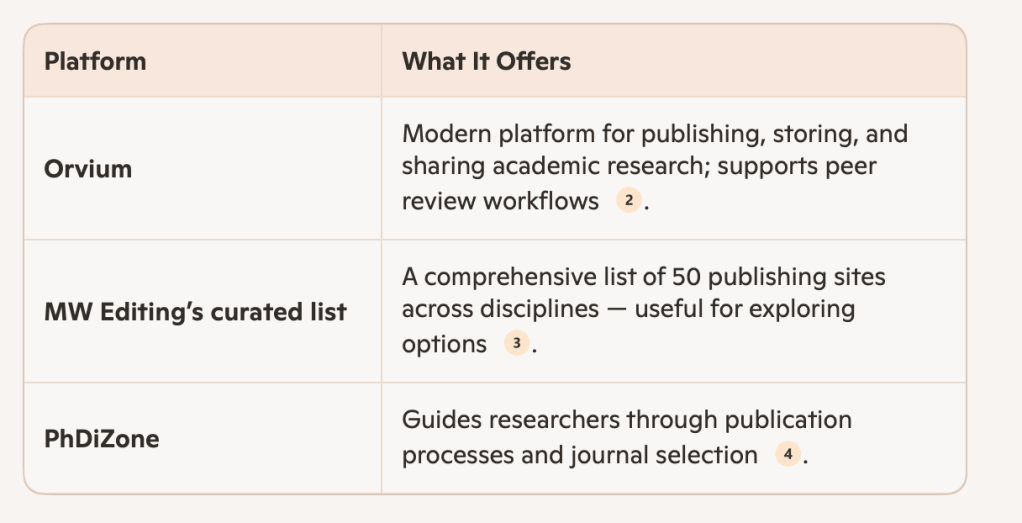
🌐 Key Research Platforms for Publishing & Sharing Work

These platforms help researchers publish, store, and disseminate their work.

🧭 How to Choose the Right Publisher or Platform

When selecting where to publish, consider:

  • Discipline fit (STEM, humanities, social sciences)
  • Impact factor & reputation
  • Open access options
  • Peer review model
  • Publication fees (APCs)
  • Indexing (Scopus, Web of Science, PubMed)
  • Speed of review & publication
  • Copyright & licensing

⚡ Quick Takeaway

If you want prestige and visibility, the big publishers (Elsevier, Springer Nature, Wiley) dominate.  

If you want speed, openness, and modern workflows, platforms like Orvium or curated lists of niche journals can help you find the right fit.

Posted in Global Research Community, global research network

Efficiently Extract Key Findings from Research Papers


Meet 𝐀𝐧𝐬𝐰𝐞𝐫𝐓𝐡𝐢𝐬—a tool that extracts data in seconds.

Here is how it works.

1. Go to https://lnkd.in/d3kqBK6J and log in

2. After logging in, click on 𝐸𝑥𝑡𝑟𝑎𝑐𝑡 𝑑𝑎𝑡𝑎

3. Then click on 𝑈𝑝𝑙𝑜𝑎𝑑 𝑃𝐷𝐹 and upload your papers

4. These are the papers from which you want to extract data

5. After uploading papers, select data you want to extract.

6. The predefined options are

– Key findings
– Research gaps
– Methodology
– Limitations
– Future work
– Contributions
– Practical implications

7. You can also extract custom data e.g., the dataset used.

8. For example, I want to extract methodology used in these papers

9. I selected Methodology and clicked on 𝐴𝑑𝑑 𝐶𝑜𝑙𝑢𝑚𝑛

10. Answer This extract data about methodology used in the papers

11. You can change data view from normal to Table View

12. For this, scroll back to top and click on 𝑇𝑎𝑏𝑙𝑒 𝑉𝑖𝑒𝑤

13. Now for instance, you want to extract more data from these papers

14. Go back to the top and click on 𝐸𝑥𝑡𝑟𝑎𝑐𝑡 𝑑𝑎𝑡𝑎

15. Select the data type you want to extract

16. For example, I want to extract data about future work

17. So I click on 𝐹𝑢𝑡𝑢𝑟𝑒 𝑊𝑜𝑟𝑘 and then clicked on 𝐴𝑑𝑑 𝑐𝑜𝑙𝑢𝑚𝑛

18. AnswerThis extracted data about future work from the papers

19. After extracting the desired data, you can export it

20. Select the data you want to extract

21. Then click on 𝐸𝑥𝑝𝑜𝑟𝑡 𝑑𝑎𝑡𝑎

22. Your data will be exported in CSV format

You can then analyze this data for your literature review


Try AnswerThis today: https://lnkd.in/d3kqBK6J

Posted in Global, Global Research Community, global research network, publication

Best Apps for Managing References and Drafting Papers

𝐅𝐢𝐧𝐝𝐢𝐧𝐠𝐬 𝐩𝐚𝐩𝐞𝐫𝐬

ResearchRabbit ➝ www.researchrabbit.ai
Bohrium ➝ https://www.bohrium.com/

𝐑𝐞𝐚𝐝𝐢𝐧𝐠 𝐩𝐚𝐩𝐞𝐫𝐬

NotebookLLM ➝ https://notebooklm.google/
Outread ➝ https://www.outread.ai/

𝐖𝐫𝐢𝐭𝐢𝐧𝐠 𝐥𝐢𝐭𝐞𝐫𝐚𝐭𝐮𝐫𝐞 𝐫𝐞𝐯𝐢𝐞𝐰

Gatsbi ➝ https://www.gatsbi.com/
Overleaf ➝ www.overleaf.com

𝐃𝐚𝐭𝐚 𝐞𝐱𝐭𝐫𝐚𝐜𝐭𝐢𝐨𝐧

moara ➝ https://www.moara.io/
Paperpal ➝ https://lnkd.in/d_HFd4QT

𝐃𝐚𝐭𝐚 𝐚𝐧𝐚𝐥𝐲𝐬𝐢𝐬

MS Excel ➝ https://lnkd.in/gXdhyrr4
Nvivo ➝ https://lnkd.in/g4mESped

𝐌𝐚𝐧𝐚𝐠𝐢𝐧𝐠 𝐫𝐞𝐟𝐞𝐫𝐞𝐧𝐜𝐞𝐬

Mendeley ➝ https://www.mendeley.com/
Zotero ➝ https://www.zotero.org/

𝐂𝐫𝐞𝐚𝐭𝐞 𝐟𝐢𝐫𝐬𝐭 𝐝𝐫𝐚𝐟𝐭

AnswerThis ➝ https://lnkd.in/dm9xdAfx
SciSpace ➝ https://lnkd.in/gv8FpUpU

𝐅𝐢𝐧𝐝 𝐫𝐞𝐟𝐞𝐫𝐞𝐧𝐜𝐞𝐬

Liner ➝ https://liner.com/
Grabstract ➝ https://grabstract.io/

𝐏𝐫𝐨𝐨𝐟𝐫𝐞𝐚𝐝 𝐲𝐨𝐮𝐫 𝐩𝐚𝐩𝐞𝐫

Reviewer3 ➝ www.reviewer3.com
Thesify ➝ https://www.thesify.ai/

𝐉𝐨𝐮𝐫𝐧𝐚𝐥 𝐫𝐞𝐜𝐨𝐦𝐦𝐞𝐧𝐝𝐚𝐭𝐢𝐨𝐧

Review-it ➝ www.review-it.ai
Sage ➝ https://lnkd.in/dYka-nqm


#phd #research #literature

Posted in Global Research Community, global research network

Best Sites to Access Research Papers for Free

  1. Sci-Hub
  2. ResearchGate
  3. Academia.edu
  4. CORE
  5. Semantic Scholar
  6. PubMed Central
  7. arXiv
  8. SSRN
  9. STOR (Free Access)
  10. SpringerOpen
  11. DOAJ
  12. EThOS
  13. Unpaywall
  14. ScienceOpen
  15. OpenAIRE
  16. OSF Preprints
  17. PaperPanda
  18. Bielefeld Academic Search Engine
  19. ERIC
  20. Citationsy Archives
  21. DeepDyve
  22. PLOS
  23. Zenodo
  24. bioRxiv & medRxiv
  25. PsyArXiv
  26. PhilPapers+
  27. HAL Archives
  28. Redalyc
  29. SciELO – Scientific Electronic Library Online
  30. WorldWideScience
  31. Research4Life
  32. Hindawi Publishing
  33. MDPI Open Access
  34. Cambridge Open Engage
  35. Wiley Open Access
  36. Nature Communications
  37. EBSCO Open Dissertations
  38. OATD (Open Access Theses & Dissertations)
  39. Digital Commons Network
  40. Internet Archive (Scholar Section)

Save and share for fellow researchers.

Posted in Global Research Community, global research network

Evidence-Based Research: A Step-by-Step Approach


1. How to write a literature review (60 min video)

What do reviewers look for in a literature review?

How to conceptualize and write a review?

Common myths about literature reviews.

Link: https://lnkd.in/gRsWFvdy

2. How to identify research gaps (12 min video)

What is the research gap?

Steps for identifying research gap.

Tools for identifying research gap.

Link: https://lnkd.in/gvxgD95D

3. How to conduct evidence-based research (38 min video)

What is evidence-based research?

Stepwise approach for conducting evidence-based research.

How to enhance reliability of your research?

Link: https://lnkd.in/gMUxXybm

4. How to find relevant research papers? (15 min video)

How to conduct basic search?

Save searches and set up alerts.

How to download and export searches?

Link: https://lnkd.in/gKXauFHr

5. How to write an abstract (40 min video)

Why a good abstract is important?

What is ideal length of abstract?

What to include in the abstract?

Link: https://lnkd.in/g9drbDZF

6. How to secure funding? (60 min video)

How to write grant application?

What funders look for in grant applications?

Tips for winning grants.

Link: https://lnkd.in/g-diuMPv

7. How to use Gen AI in research (53 min video)

How has Gen Al impacted research?

How to use Scopus Al search tool?

Future of Gen Al in research

Link: https://lnkd.in/gepXEzBf


8. Author policies on the use of Generate AI (11 min video)

Ethical cases related to Generative Al

Opportunities offered by Generative Al

Risks posed by Generative Al

Link: https://lnkd.in/gT4Xg7y

9. How to write cover letter for your manuscript (8 min video)

Importance of a good cover letter

How to write a strong cover letter?

What to include in the cover letter?

Link: https://lnkd.in/gFA_pNkD

10. How to respond to reviewers’ comments? (37 min video)

Understanding reviewers’ comments

How to write response to each comment?

How to increase your chances of paper acceptance?

Link: https://lnkd.in/gcG7mxrc

hashtag#research hashtag#scientificwriting hashtag#freecourses hashtag#onlinecourses hashtag#elsevier hashtag#science hashtag#phd